

I met her in Galway on a wet Thursday evening, the kind of evening that makes every pub window look like a small rescue. I had gone west from Dublin after a week that had left me feeling older than I was. Nothing dramatic had happened, not really. I had not lost my job or been left at the altar. I was simply tired in that quiet, private way people get tired when they keep saying they are fine.
I was thirty-two then, living near Rathmines, working in an office off Grand Canal Dock, and carrying around the belief that life was supposed to be more settled by that age. My friends were buying houses in places I could not afford, having babies, getting promoted, posting photographs from Portugal and West Cork. I was renting a room with a damp patch above the wardrobe and reheating pasta over a hob that clicked like it was judging me. I told myself a few days in Galway would clear my head.
The pub was down a narrow street not far from the Latin Quarter. I remember the door sticking slightly when I pushed it open, the smell of rain off coats, turf smoke, stout, and something frying in the kitchen. A trad session had started in the corner. Two fiddles, a flute, and a man tapping his shoe like he was keeping the whole county alive by force of rhythm. I found a stool at the bar because sitting at a table alone felt too much like admitting something.
She was already there, two seats down, reading a paperback with a cracked spine. That was the first thing I noticed. Not her face, though I noticed that soon enough, but the fact that she was reading in a crowded pub as if the noise belonged to the book. She had dark hair cut to her chin, a green jumper with one sleeve slightly unravelled, and a pint of something amber in front of her. She looked comfortable with herself, which made me aware of how uncomfortable I was with myself.
I would like to say I spoke first with confidence, but that would be improving the memory for the sake of pride. The barman asked whether I wanted another, and when I said yes, she glanced over and told me I had chosen the loudest corner if I had come to think. It was not flirtatious exactly. It was just true. I laughed because I had come to think, and the idea that a stranger could see it on me felt both embarrassing and relieving.
Her name was Maeve. She was from Mayo, living in Galway for a year while working in a small gallery. She told me this with no performance, no list of achievements attached. I told her I was from Dublin, though not originally, and that I worked in a job that sounded better in emails than it felt in the body. She smiled at that. There was a way she listened that made me careful with my words, not because I feared judgement, but because I did not want to waste the attention.
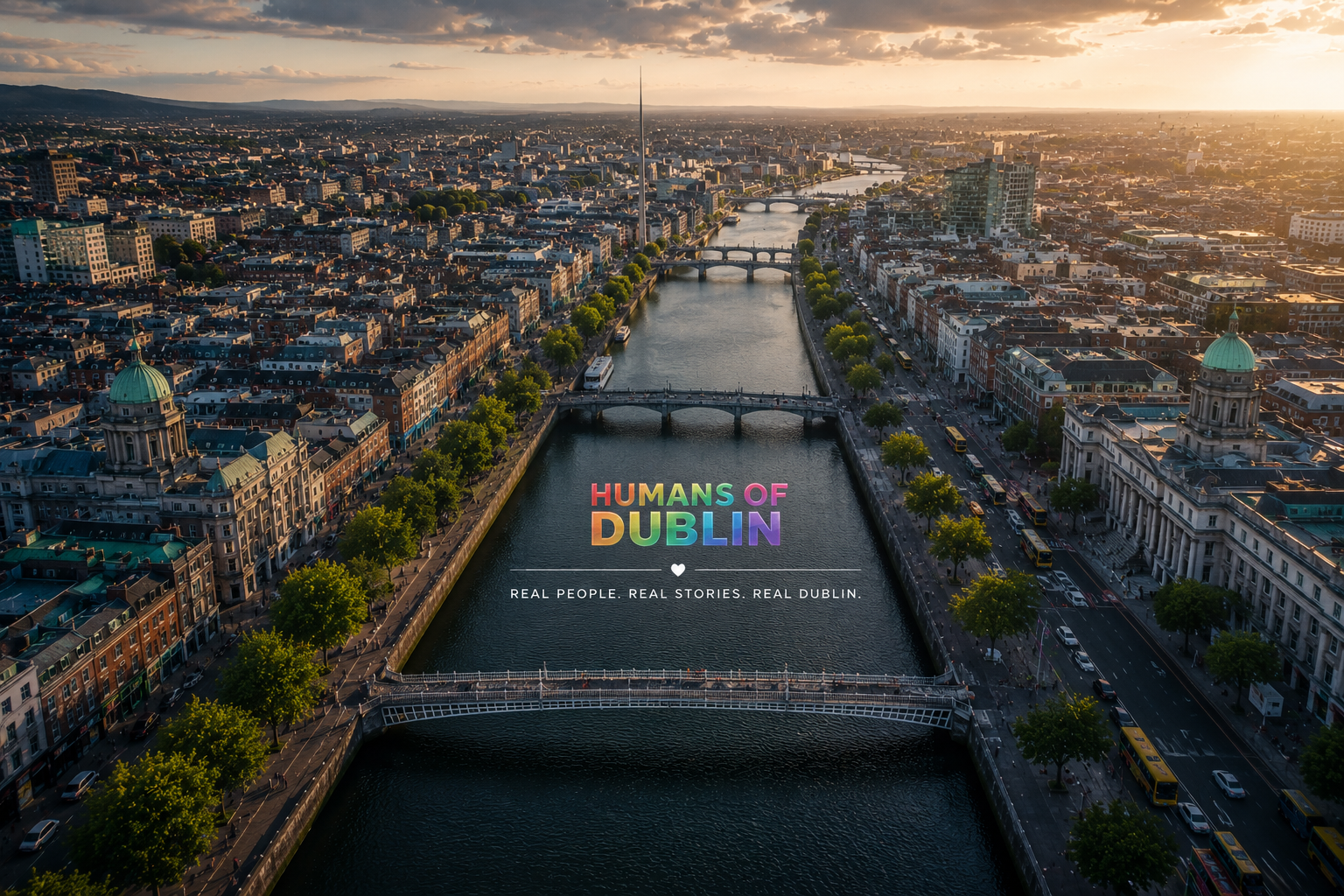
We did not have one of those grand conversations that films give strangers, where every sentence lands like fate. We spoke about ordinary things. Bad landlords. The first album we each bought. How lonely a full city can feel. Whether Galway rain was more honest than Dublin rain. She said Dublin moved like it was late for itself, and I knew exactly what she meant. I told her I often walked along the Liffey after work, past Ha’penny Bridge and Temple Bar, pretending I was on my way somewhere important when really I was just delaying going home.
At some point the music got louder and the pub filled until people were leaning into one another to be heard. Maeve closed her book and placed it between us on the bar, using it as a kind of border and bridge. She had a habit of touching the rim of her glass before she answered a question. I remember her hands more clearly than I remember some of my own family holidays. That is the strange cruelty of memory. It keeps what it likes.
I told her, after two pints, that I had come to Galway because I felt stuck. It slipped out more honestly than I intended. She did not offer advice. She did not say everything happens for a reason, which is a phrase I have always found too tidy for real pain. She only said that being stuck is sometimes the moment before you admit you want something else. Then she looked away toward the musicians, as if she had said too much or exactly enough.
That sentence stayed with me. At the time, I only nodded. I might even have made some joke to cover how closely it had landed. But inside, something shifted. Not in a thunderclap way. More like a door in an old house easing open because the wind has changed.
When the session ended, the room seemed suddenly exposed. People clapped, coats were lifted from hooks, chairs scraped along the floor. Maeve asked if I wanted to walk. We stepped outside into a soft mist that made the streetlamps blur at the edges. Galway at night has a way of making even a stranger feel briefly claimed. We walked without a plan, past shopfronts and late students and couples huddled under one umbrella. Our shoulders touched once, by accident, and neither of us mentioned it.
Near the river, she told me she was leaving Galway in two weeks. She had been offered a place on a course in France, something to do with restoration and old paintings. She said she was excited, then admitted she was frightened. I found this comforting, that someone who seemed so composed still carried fear around with her like everyone else. I told her I envied her for going. She said envy was often just a map folded badly.
I thought about kissing her then. I know that sounds like the predictable turn, but it is the truth. There was a pause by the water, and the city noise dropped away for a second, and I felt the evening gather itself into one possible shape. But I did not kiss her. Some part of me knew that reaching for romance too quickly would cheapen what had already happened. Or maybe I was simply afraid. Most noble choices, if inspected closely enough, contain a little cowardice.
She gave me her number before we parted. Not dramatically. She wrote it on the inside of a receipt with a borrowed pen from her bag. The rain had softened the paper by the time she handed it to me. She said she was glad I had chosen the loudest corner. I said I was too. Then she hugged me, briefly but warmly, and walked away toward the Spanish Arch, her green jumper visible for a few seconds before the night took it.
Back at my guesthouse, I placed the receipt on the bedside table and looked at it as if it were proof of something. I did not sleep much. The next morning, I took the bus back to Dublin with a headache and a sense that I was carrying a lit match in my chest. Somewhere past Athlone, I checked my pocket for the receipt. It was not there.
I searched everything. My coat, my bag, the book I had brought and not read, the pocket inside the pocket where old tickets go to die. Nothing. I rang the guesthouse. A kind woman checked the room and found only a phone charger that was not mine. I could remember Maeve’s face, the colour of her jumper, the exact way she had said certain words, but not the number. Not even the first three digits. It was absurd how quickly a person could become unreachable.
For a week, I was ashamed of how much it bothered me. We had only shared one evening. I had no right to miss her, no claim on her future, no tragedy to name. Still, I found myself looking for her in places she had never been. On Grafton Street, in the queue at Fallon & Byrne, across a crowded carriage on the Luas. I went for my usual walks by the Liffey, but the city looked different, as if someone had adjusted the focus. I noticed people more. Their tired faces, their private weather, the small acts of tenderness they performed without ceremony.
I did not find Maeve. What I found, slowly and reluctantly, was the part of myself I had been avoiding. Her sentence about being stuck would not leave me alone. A month after Galway, I asked to reduce my hours at work and enrolled in an evening course in creative writing near Parnell Square. It felt foolish and self-indulgent, which is often how necessary things feel at the beginning. I started writing small pieces about people I saw in cafés, on buses, outside pubs smoking under awnings. Nothing remarkable, only human.
Two years later, I was in a small exhibition space off Francis Street when I saw a painting of a woman standing at a pub window, her reflection layered with rain and streetlight. The artist’s name on the card was not Maeve’s. Still, the painting stopped me because it carried the feeling of that night so precisely that for a moment I had to steady myself. I thought about how many people pass through us without staying, and yet leave behind a room we continue to visit.
I never met Maeve again. I do not know whether she went to France, whether she restored old paintings, whether she married, whether she thinks of that wet night in Galway at all. For a long time, I wanted the story to end with a reunion, with me finding the receipt tucked into some forgotten fold, with a message sent years late and answered within minutes. But life is not always careless in ways that can be repaired.
What did happen is quieter. I changed direction. Not completely, not overnight, but enough. I left the job a year later and found work with a small arts charity. I moved out of the damp room. I learned how to be alone without treating it as a punishment. I wrote more. I loved again, though not immediately and not without bringing my old fears with me. When I eventually told the woman I am with now about Maeve, she did not feel threatened. She said some people are not meant to stay; they are meant to return us to ourselves.
I still think of the Galway pub when rain hits a window at night. I think of the music and the crowded bar, of a paperback placed between two strangers, of a woman in a green jumper who listened as if listening were a form of kindness. She never became part of my life in the ordinary sense. She never met my friends, never learned my coffee order, never saw Dublin through my eyes. But she changed the way I moved through it.
The woman I met at a Galway pub never left my mind, not because she was the great love I lost, but because she arrived at the exact moment I had stopped expecting anything to arrive. She reminded me that a single evening can be enough to loosen a knot. That a stranger can hand you a sentence and unknowingly alter the shape of your days. That love, or something close to it, is not always about possession. Sometimes it is only a brief light in a wet street, showing you the road you had been afraid to take.
Humans of Dublin, Galway, Love, Irish Pubs, Missed Connections, Dublin Stories